

Management Plan 2026 - 2031
Nature
The Quantock Hills is home to special habitats and species, a result of its geology, historic and current land use. From the open unenclosed heathlands, the acidic mires, extensive broadleaved woodland through to the intricate network of hedgerows and banks surrounding the species-rich grasslands, the habitats of the Quantock Hills are fragile. Core areas often fragmented and disconnected, need to be restored and connected not only for the benefit of nature but to deliver other ecosystem services.
4.1 Context and significance
The Quantock Hills National Landscape is a valuable place for wildlife. From bats, dormice and adders, to lichen, beetles, trees and wildflowers the Quantock Hills has a vast diversity of habitats and species in a relatively small land mass. This has been recognised in the fact that it was England’s first Area of Outstanding Natural Beauty and protected by three Sites of Special Scientific Interest, a Special Area of Conservation, numerous Local Wildlife Sites and an Important Bird Area.
As well as the importance of the core of the Quantock Hills for nature, it is strategically located to provide networks and corridors and support species in adapting to climate change by moving to a new climate space, whether a change in altitude and hydrology from the levels to the east and south of the hills or linking to the habitats of neighbouring protected landscapes such as Exmoor National Park and the Blackdown Hills National Landscape.
However, the story of the loss of our wildlife is well documented and understood, locally most recently with The Somerset State of Nature report 2023
For many years we have known that wildlife will need certain conditions to allow it to adapt to climate change. Making Space for Nature: A review of England’s Wildlife Sites and Ecological Network (Lawton, 2010) identified that wildlife will need to be able to move to a new niche (ecological home), usually northwards to a new climate space. For this to happen there needs to be large “core” areas of varied habitat, rich in different gradients and aspects offering new niches, and a robust nature network that allows wildlife to move across the landscape.
The Lawton Report describes what we need to do to create a network that will allow wildlife to recover and adapt to climate change.
“What needs to be done… can be summarised in four words: 'more, bigger, better and joined'. There are five key approaches which encompass these and also take account of the land around the ecological network. We need to:
-
Improve the quality of current wildlife sites by better habitat management.
-
Increase the size of current sites.
-
Enhance connections between, or join up, sites, either through physical corridors, or through ‘stepping stones’.
-
Create new sites.
-
Reduce the pressures on wildlife by improving the wider environment, including through buffering wildlife sites.”
The 25 Year Environment Plan – GOV.UK launched by government in February 2018 robustly addresses biodiversity issues in respect of protection for threatened species and richer wildlife habitats. It commits to an environment first approach to agriculture, forestry, land use and fishing and in 2020, the UK government set a challenging target, to enhance biodiversity by protecting and managing 30% of the land, rivers and sea by 2030 ( Environmental Improvement Plan ) – part of a global effort known as “30 by 30”. A global 30 by 30 target was adopted at the UN Biodiversity Summit COP15 in December 2022, as part of an ambitious Global Biodiversity Framework. The Government has set out some mechanisms it believes will deliver this commitment including the formation of new Protected Landscapes, the delivery of its Environmental Land Management Schemes (ELMS), implementation of Biodiversity Net Gain and increases in blended finance to draw in greater private investment.
Protected Landscapes have been identified to deliver more resilient and coherent ecological networks. In April 2024 the National Landscape Partnership published its first Nature Recovery Plan, which was developed in consultation with partners, community groups and other stakeholders. The aim was to engage partners and inspire and inform positive actions to conserve existing habitat and species and create the conditions to expand the nature rich area across the National Landscape. The consultation formed a collective view about the pressures and actions for nature recovery.
The plan identified the main land cover across the entirety of the National Landscape. This all-encompassing approach was taken to create a holistic agenda for nature recovery, recognising the importance of measures which can be taken across the farmed and forested landscape. In total 93 pressures and subsequent actions were identified.
Within the Quantock Hills, as throughout the world, a combination of factors, caused mainly by human activity over recent decades, has caused nature to struggle. Species and habitats are being lost or have deteriorated drastically due to:
-
Changes in land use
-
Development
-
Resource extraction
-
Pollution
-
Invasive / non-native species
-
Climate change
-
Recreational pressures
Intensification of farming has had a catastrophic effect on habitats and wildlife. Following the Second World War technological innovations coupled with successive government policies promoted high input and high output farm production with national loss of key habitats such as species-rich grasslands (47% decline between 1960 – 2013) and dry acid grassland and heathland (85% decline).
Inappropriate development, including the associated infrastructure, has the potential to negatively impact habitats and species. While development levels within the National Landscape are relatively low, there has been significant growth in housing and other development in the towns and villages surrounding the Quantock Hills, including Hinkley Point C, currently Europe’s largest development. While there has been some impact from habitat loss, it is the increasing fragmentation of habitats, along with issues such as loss of tranquillity (increasing disturbance) and issues such as light pollution which are impacting species.
Agriculture and development both have the potential to impact water quality. Within Somerset issues of nitrogen enrichment, phosphates and sedimentation have impacted waterbodies, especially the Somerset Levels and Moors. Parts of the Quantock Hills are within Nitrate Vulnerable Zones (NVZ) and the Tone Nutrient Neutrality Catchment.
Current modelling of the impacts of climate change show that the Quantock Hills are likely to get warmer, summers will continue to get warmer and drier, and winters will continue to get milder and wetter. Rainfall intensity is likely to increase with periods of heavy rain causing more frequent flood events. All owners and managers of the land will also be seeking to reduce the impacts of climate change on their land and livelihoods. Building resilience to climate change is an increasing challenge for all farmers and also for the conservation of habitats and wildlife. A significant threat is the increased likelihood of wildfires on the heathlands and grasslands, especially the main plateaus. These occurrences risk damage to grazing, harm to livestock, people and property. They can also severely impact fragile habitat and wildlife populations. Climate change is impacting species as well. Monitoring of key species such as Pied Flycatcher has shown that migration timings are changing, being on average 2 weeks earlier than 40 years ago, without the corresponding changes in timings for peak caterpillar emergence, their main prey species. This type of disconnect is expected to increase for many migratory species.
Changing climate, along with increasing international trade, have increased the prevalence of pests and diseases impacting our native wildlife and habitats as well as increasing the impact of non-native invasive species. Tree diseases such as Phytophthora ramorum and Ash dieback have had significant impacts on the habitats of the Quantock Hills over the last 15-years, especially the mixed broadleaved woodlands in the southern extent of the National Landscape. Invasive species such as Rhododendron are impacting the heathlands and extensive species-rich grasslands.
The Quantock Hills National Landscape contains a wealth of Designated Sites. Sites of Special Scientific Interest (SSSIs) are nationally important and there are three, The Quantocks, Blue Anchor to Lilstock Coast and Ge-Mare Farm Fields, contained within the Quantock Hills covering 2,672Ha (27% of the National Landscape). The Quantocks SSSI is designated for its heathlands, extensive acidic grassland, acidic mires, deciduous woodlands and breeding birds. The coastal edge of the National Landscape, designated as SSSI largely for its Triassic and Jurassic geology, including foreshore and cliff habitats supports specific ranges of flora and fauna, primarily due to the alkaline, limestone cliffs. Specialised cliff-top biodiversity includes orchids, limestone grassland and invertebrates.
In 2023 47.5% of the SSSI was in “favourable” condition, an increase from 16.1% in 2017. While this is encouraging the area in “unfavourable declining” condition has also increased from 1.8% to 11.5% over the same time period with factors such as scrub encroachment,
In April 2023 Natural England changed its approach to SSSI monitoring. Instead of subdividing SSSIs into units and making assessments of condition at the unit scale, they will assess the condition of the special features across the whole of a SSSI. This will mean that 2024 SSSI condition assessment will form a new baseline.
In addition to the SSSIs there is one Special Area of Conservation (SAC) within the Quantock Hills, a site of European importance for nature conservation, covering the upland oak woodlands on the northern part of Quantock Common. This forms part of the Exmoor and Quantock Oakwoods – Special Areas of Conservation and was designated due to the extensive tracts of old sessile oak woods in conjunction with heath habitats and the presence of Barbastelle bats. Taking a landscape scale approach to ensure habitat connectivity beyond the SAC is required to maintain a viable population of this species. Just outside the National Landscape boundary at the southern end is Hestercombe House – Special Areas of Conservation which has been designated due to the presence of a large maternity site of less horseshoe bats.
The Quantock Hills National Landscape includes areas of 13 different priority habitats from the list of priority habitats and species in England (Section 41 habitat and species NERC Act 2006). These habitats are conservation priorities because of their rarity and rate of decline: Together they total 3,283Ha (33% of the National Landscape). There are 35 Section 41 species present in the Quantock Hills National Landscape, 3 of which are in the top 10 NCAs in the country for the species.
The Quantock Hills is relatively well wooded at 3,133Ha, which is 32% of the National landscape area. This includes woodlands and trees outside of woodlands, such as hedgerows, wood pasture and orchards (Forestry Commission 2023, PLTOF). The diversity of woodland types coupled with the extensive network of native species hedgerows means that the Quantock Hills has a high degree of connectivity. However, there are some issues affecting the woodlands on the Quantock Hills such as even age structure, lack of regeneration and closed canopy in the sessile oakwoods, or impact of ash dieback on the woodlands in the southern part of the National Landscape. As well as significant areas of hedgerows, the farmed landscape contains a significant area of small woodland / copses.
Nationally deer are thriving with significant increase since the Covid-19 pandemic, with Forestry Commission estimating numbers in Britain having increased from 450,000 in the 1970’s to about 2 million now. They are the largest free roaming animal in the UK with Red Deer – the largest native deer species – weighing between 70 and 180kg. The Red Deer herds of the Quantock Hills form an important part of its ecology and cultural heritage, with many from local communities and visitors alike specifically visiting the hills for the opportunity to observe the deer.
While Red and Roe deer are native species, their populations on the Quantock Hills has grown from very few in 1862 to over 1,000 in the last few years. Ground surveys, led by the Quantock Deer Management and Conservation Group, of the red deer population have been undertaken since 1990, giving a minimum population number. Over the years this has varied however the count of 2024 counted over 1,100 red deer. The same year a thermal drone survey identified 1,300 red deer and over 400 roe deer with an estimated density of 19.2 animals per km2. Densities above 10 animals per km2 are seen as too high. Invasive species such as Muntjac and Fallow are also present, but currently in smaller numbers.
In high densities deer can have significant negative impacts, such as damage to trees from browsing, overgrazing heath and grassland, trampling especially of agricultural crops, increased risk of disease transmission and road traffic collisions. It is acknowledged that current populations of deer are too high and coordinated action is required to reduce the numbers of deer to more sustainable levels.
Illustration: From top left, Skylark, Greater Horseshoe bat, Dormice and, Brown hairstreak butterflies, some of the species of importance in the Quantock Hills. © Phil Collins

Brown hairstreak

Hazel dormouse
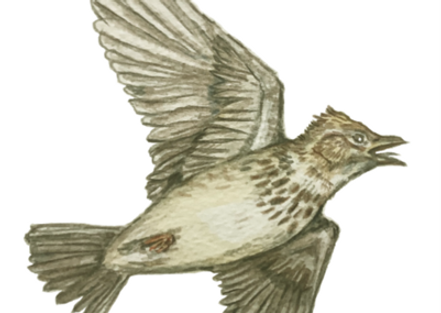
Skylark

Greater horseshoe bat
4.2 Guiding principles - Nature
Principle 1: The natural landscape of the Quantock Hills should be seen as a functioning whole
Wildlife habitats and species are part of a whole ecosystem, which includes our soils, water cycle, landform, rivers, and our human settlements. To pursue the health of any part of the nature of the Quantock Hills, we need to understand how the whole ecosystem is structured, how it works, and where its functioning is being compromised.
Principle 2: To thrive, areas of wildlife habitat in the Quantock Hills need to be bigger and more connected
Smaller, more isolated patches of wildlife habitat are more vulnerable than larger, more connected networks. They have more “edge” relative to their area, and so are more affected by what is happening outside them. Populations of species like butterflies in isolated habitat patches cannot migrate to new patches. We will not retain our wildlife unless habitat becomes more extensive and connected.
Principle 3: Some Quantock Hills habitats and species are more threatened than others
Some of the habitats and species in the Quantock Hills only occur in certain parts of the landscape – for example temperate rainforests, in the wetter northern combes over sandstone geology, and raft spiders, which only live on acidic mires. Other habitats have a wider tolerance. To look after the diversity and specialness of Quantock Hills wild places, we need to ensure our most characteristic and unique features are retained.
Principle 4: Quantock Hills wildlife is an expression of natural and human influence
While some aspects of modern farming and forestry, and the economic pressures which drive them, have had a negative impact on wildlife in the last fifty years, the very character of our habitats is a consequence of farming, forestry and nature working in harmony. Without farming, we would not have flower-rich pastures, meadows or heaths. We need to enable the positive effects of sustainable farming to continue to produce a wildlife-rich landscape, while diminishing the negative effects.
Principle 5: Quantock wildlife habitat isn’t only good for wildlife
Existing wildlife habitats like wetlands, mires, hedges, copses and ponds help us in many ways: they hold water back during floods, they retain moisture during droughts, they provide shelter for livestock, and they catch sediment before it reaches rivers. New wildlife habitat, if sited thoughtfully, can help us address the wider environmental pressures we face.
Principle 6: When making new space for nature, the right habitat needs to be created in the right place
The Quantock Hills is limited in size with significant areas of nature rich habitat. Sometimes, creating a new habitat can destroy an existing habitat, for example by planting woodland on flower-rich pasture on a slope. Furthermore, new habitats will be most valuable for wildlife if they are sited close to existing good quality habitats of a similar kind. And unless the soil type and hydrology are right for a given habitat, it won’t thrive.
Principle 7: Climate change affects different species and habitats in the Quantock Hills in different ways
Wildlife in the Quantock Hills, just like human society, is at risk from the effects of climate breakdown – flood, drought, high winds and high temperatures. Some habitats and species are more vulnerable than others, because of their location, exposure, or relationship to landscape features which are particularly impacted by severe weather events.
Principle 8: Thriving nature in the Quantock Hills isn’t neat and tidy
Nature doesn’t like being confined. Often the ecologically richest places are in the “edge zone” between habitats – where a hedge is able to spread into the margins of a field, or pasture and scrub form a mosaic with each other. We help nature to flourish where we allow it to relax and flow, at least a little.
Principle 9: People need nature, wherever they are and whatever their ability or knowledge
Wherever they occur, wildlife habitats and species can and should benefit people. Nature is good for our mental and physical health, helps us work better together, provides quality of life, provides settings and resources for business, and underpins everything that makes our society function.
Principle 10: What happens in the Quantock Hills is contributing to something much bigger
The wildlife we protect and restore in the Quantock Hills will contribute towards a national effort to restore a thriving, functioning natural environment across the UK. The UK has an international commitment to protect 30% of land for nature by 2030, and we can deliver a significant slice of that target.
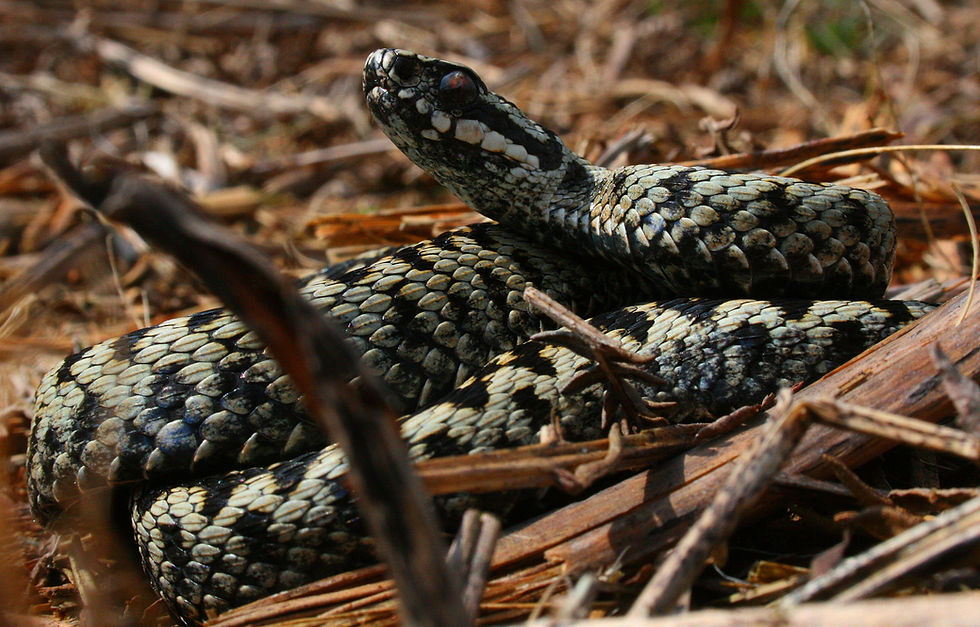
Photo: European Adder, one of the six Champion Species. © Kevin Palmer
4.3 Aims – Nature
That biodiversity is protected in the National Landscape and further enriched through positive management and increased connectivity between key wildlife habitats across the whole Quantock landscape allowing nature to thrive and grow.
4.4 Objectives – Nature
N1: To maintain and enrich the biodiversity and ecosystems of the Quantock Hills at the landscape scale, ensuring management supports nature recovery, conserves and enhances natural beauty, ecosystems and its services, such as clean air and water.
N2: To increase knowledge and understanding of the biodiversity and ecosystems of the Quantock Hills and their linkage to the surrounding area informing holistic land management for nature, climate and food production – that minimises or reverses nature loss.
4.5 Current status – Nature
-
There are three Sites of Special Scientific Interest (SSSI’s) in the Quantock Hills National Landscape covering 2,672Ha (27%) of its area, plus one Special Area of Conservation.
-
In 2023 78% of the Quantock Hills SSSI are in “favourable” or “unfavourable recovering” condition, a reduction from 91.2% in 2017. However, the proportion in “favourable” condition has increased from 16.1% to 47.5% and in “unfavourable declining” from 1.8% to 11.5% in the same period.
-
From 2023 Natural England has changed the way in which SSSI are monitored and their condition assessed. There are two measures, the SSSI features in favourable condition and the actions on track to achieve favourable condition. In 2025
-
SSSI features in favourable condition = 20%
-
SSSI with actions on track to achieve favourable condition = 2 (20%)
-
There are 3,364Ha of priority habitats covering 34% of the Quantock Hills National Landscape.
-
There is 3,133Ha of woodland and trees outside woodland which is 32% of the Quantock Hills National Landscape.
-
Of this, 1,150Ha is ancient woodland which is 11.6% of the National Landscape
-
77% of woodland is in active management.
-
There is one Important Bird Area that is over 2,000Ha.
-
The ecological quality of the waterbodies of the Quantock Hills is poor to moderate. None are in good or high status.
4.6 Targets – Nature
Government has set targets for Protected Landscapes under the Protected Landscapes Targets and Outcomes Framework (see appendix 1 [pdf]). The Quantock Hills National Landscape will contribute to the following targets under the PLTOF:
Target 1
Restore or create more than 250,000Ha of a range of wildlife-rich habitats within Protected Landscapes, outside protected sites by 2042 (from a 2022 baseline).
Farmers will also be supported to create or restore 30,000 miles of hedgerow a year by 2037, eventually returning England’s hedgerows to 10% above their 1984 peak of 360,000 miles.
Quantock Hills National Landscape contribution towards the Target – Set an ambitious target, guided by evidence provided by EcoNet (Figure 4), of restoring or creating more than 1,328Ha, equivalent to 66.4Ha per year. Together with existing wildlife-rich habitat this would create 5,843Ha over the Quantock Hills National Landscape b 2042. Over the period of this Management Plan this equates to 332Ha.
Target 2
Bring 80% of Sites of Scientific Interest (SSSI) within Protected Landscapes into favourable condition by 2042.
Difficult to understand baseline of SSSI condition as many features have not been assessed recently. Assessment will allow partners to understand actions required to achieve target. 2025 PLTOF data shows 20% of SSSI features within the Quantock Hills as being in favourable condition.
Quantock Hills Contribution towards the Target – To bring at least 80% of Sites of Special Scientific Interest within the Quantock Hills National Landscape into favourable condition by 2042.
Target 3
60% of SSSIs within Protected Landscapes assessed as having “actions on track” to achieve favourable condition by 31 January 2028.
Baseline data has been presented by Natural England that shows the number of features with actions on track to achieve favourable condition. Of the 10 features of the SSSI within the Quantock Hills National Landscape 2 (20%) are deemed positive, with 8 (80%) negative. “Negative” refers to actions which have not been yet undertaken, or which are resulting in a negative impact on the SSSI. The majority of features do not have up to date condition assessments to be able to determine whether any prescribed actions are “on track”. Note – This does not include Blue Anchor to Lilstock SSSI as less than 30% of it is within the National Landscape.
Target 4
Continuing favourable management of all existing priority habitat already in favourable condition outside of SSSIs (from a 2022 baseline) and increasing to include all newly restored or created habitat through agri-environment schemes by 2042.
Quantock Hills Contribution towards the Target – To retain 1,288Ha of land in Agri-Environment Schemes outside of SSSI and to increase land in Agri-Environment Schemes outside of SSSI that has restored or created priority habitat by 40Ha.
Target 5
Ensuring at least 65% to 80% of land managers adopt nature friendly farming on at least 10% to 15% of their land by 2030.
Difficult to set a target with two variables. Recommend approach to select higher percentage of land managers (80%) with lower percentage of land (10%).
Rationale for higher percentage for engagement with land managers / farmers is that these stakeholders are key to achieving success across multiple National Landscape objectives including nature recovery, climate and socioeconomic outcomes.
The Quantock Hills National Landscape Partnership has a good level of engagement currently. However successful engagement with 80% of farmers / land managers is ambitious, though with programmes such as FiPL, should be achievable.
The rationale for the lower level of land in nature friendly farming (10%), is that we know for some of the more intensive farming systems this could be achievable, allowing more farmers to engage successfully in this target.
Quantock Hills Contribution towards the Target – Ensure at least 80% of land managers adopt nature friendly farming on at least 10% of their land by 2030.
30 by 30
The international obligation that the Government has signed up to of 30% of land and sea managed for nature by 2030 is a current major policy driver. National Landscapes (15% of England) include 31% of England’s SSSI, 22% of England’s broadleaved woodland and 18% of England’s deep peat. While the Quantock Hills National Landscape is making a considerable contribution – with 34% of land meeting the criteria for 30by30 – there is significant opportunity and ambition to contribute more.
To prioritise action the National Landscape Partnership developed the Nature Recovery Plan, which took the Lawton principles of “more, bigger, better and joined up”, and applied it to the Quantock Hills National Landscape. Utilising Natural England’s Priority Habitat opportunity mapping and Somerset Econet Data (Somerset Environmental Records Centre) the partnership has mapped the opportunity areas for habitat enhancement or creation and is using this as the basis for actions such as targeting of Farming in Protected Landscapes (FiPL) projects.

Figure 4: Priority Habitat opportunity map (Quantock Hills Nature Recovery Plan 2024).
Champion species
In conjunction with the National Landscapes network, the Quantock Hills Nature Recovery Plan identified a number of “Champion Species”. These were species that would engage the wider public, where actions linked to the Quantock Hills special qualities could be taken at a local, regional and national level.
The champion species for the Quantock Hills are:
-
Yellowhammer. A brightly coloured bird associated with hedgerows, farmland, heathland and scrubby grasslands. Relatively high populations on Quantock Hills. Easy to hear, see and identify. Good potential for wider public engagement and citizen science. Sensitive management of hedgerows and field margins can significantly boost the population.
-
Barbastelle bat. Associated with woodlands but with a long commute (up to 12km a night) between roosts and feeding areas. Easily affected by fragmented landscapes. Currently monitored through the QH Bat Monitoring and NBMP which has identified wider presence than previously thought. Good opportunity for public engagement and visualisation of landscape scale conservation. QLPS looking to further monitor through specific project including undertaking engagement and citizen science type activity.
-
Adder. A small stocky snake found in rough grassland, heathland and open woodland. They are easy to identify, usually greyish with a dark and zig-zag pattern down its back and red eyes. Widespread across the UK, their populations have declined, due mainly to habitat loss. On the Quantock Hills regular monitoring is undertaken which have identified a wide distribution but relatively low population numbers. Research also identified that the adder populations on the Quantock Hills were smaller body size than national populations.
-
Brown hairstreak butterfly. Associated with woodlands and scrub type habitat, the brown hairstreak has suffered a huge decline. They depend upon young blackthorn for their larval foodplant, where they lay their eggs on the young shoots. They also typically congregate around a nearby “master” ash tree to mate. Quite distinctive and easy to survey in late summer for adults and in winter for eggs. Butterflies are quite engaging to the general public and would be an ideal citizen science subject.
-
Nightjar. One of the later summer migrants to arrive on the Quantock Hill each year. They are associated with heathland and open ground habitats, including forestry clearfell and young conifer plantations. Quantocks have good population and monitoring has been carried out over a number of years allowing trend data. Relatively easy to identify and good opportunities to engage wider public.
-
Lesser-spotted woodpecker. Smallest and least common of the three resident woodpecker species in the UK. Distinctive black and white pattern with the males having a red cap. Very similar in pattern and colour to the Greater Spotted Woodpecker but significantly smaller. Found in open woods, copses, parkland and orchards. Mainly found in the southern part of the UK and numbers are rapidly declining. Some records in the Quantock Hills, especially in the oak woodlands in the northern combes. They typically prefer to nest in mature birch trees.
Local Nature Recovery Strategies will be identifying priority species where conservation measures are required over and above broad habitat management and restoration. It is anticipated that the champion species identified in the Quantock Hills Nature Recovery Plan will align with the Somerset Local Nature Recovery Strategy. As the timings for the strategy development are different to the Management Plan review cycle a review may be required to ensure alignment.
4.7 Policies – Nature
NA1: Support conservation and enhancement of the core protected sites of the Quantock Hills including their priority habitats such as the acid grasslands, acid flush/mires, heathlands and oakwoods.
NA2: Support initiatives that use Lawton principles of “more, bigger, better and joined” that enhance existing habitats and create networks of habitats of importance across the National Landscape.
NA3: Ensure priority habitat of importance for the Quantock Hills are protected and that the development or creation of one habitat does not damage the network of another.
NA4: Support woodland owners to undertake appropriate management to benefit nature.
NA5: Encourage woodland creation and planting of trees outside woodlands that consider the ecological value and landscape character based on “right tree, in the right location, for the right reason” principles.
NA6: Support and encourage development of funding streams / schemes that protect, connect and expand priority habitats of importance for the Quantock Hills National Landscape.
NA7: Support wildlife / habitat monitoring, including national schemes and initiatives prioritising those that monitor species / habitats of interest.
NA8: Support and promote initiatives that control or eradicate, where feasible, invasive non-native species where they threaten or damage priority habitats and species.

Photo: Bog pimpernel, found in the rare acidic mires on Quantock Common. © Quantock Hills National landscape Team